U01
Copper cable plant
Cat5e, Cat6 and Cat6A runs, home-run to a labeled patch panel.
NETWORKING & CABLING · CCB #249201 · MILWAUKIE, OR
Switches and Wi‑Fi get the credit. The copper and fiber underneath them get the blame when something drops. We pull, terminate and certify a cable plant built to carry what you plug into it today and what you plug into it in five years.
SECTION 01 / WHAT WE PULL
Copper for the desks and access points, fiber for the backbone, all of it home-run to a rack that makes sense to the next person who opens the door.
Cat5e, Cat6 and Cat6A runs, home-run to a labeled patch panel.
OM4 and OS2 for building-to-building links and anywhere copper runs out of distance.
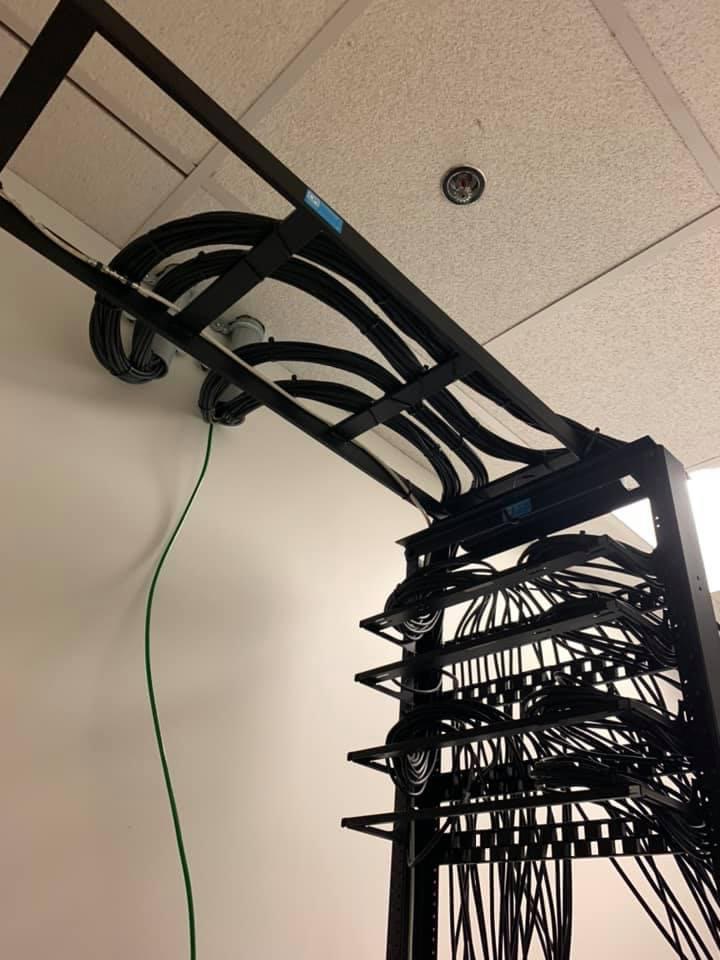
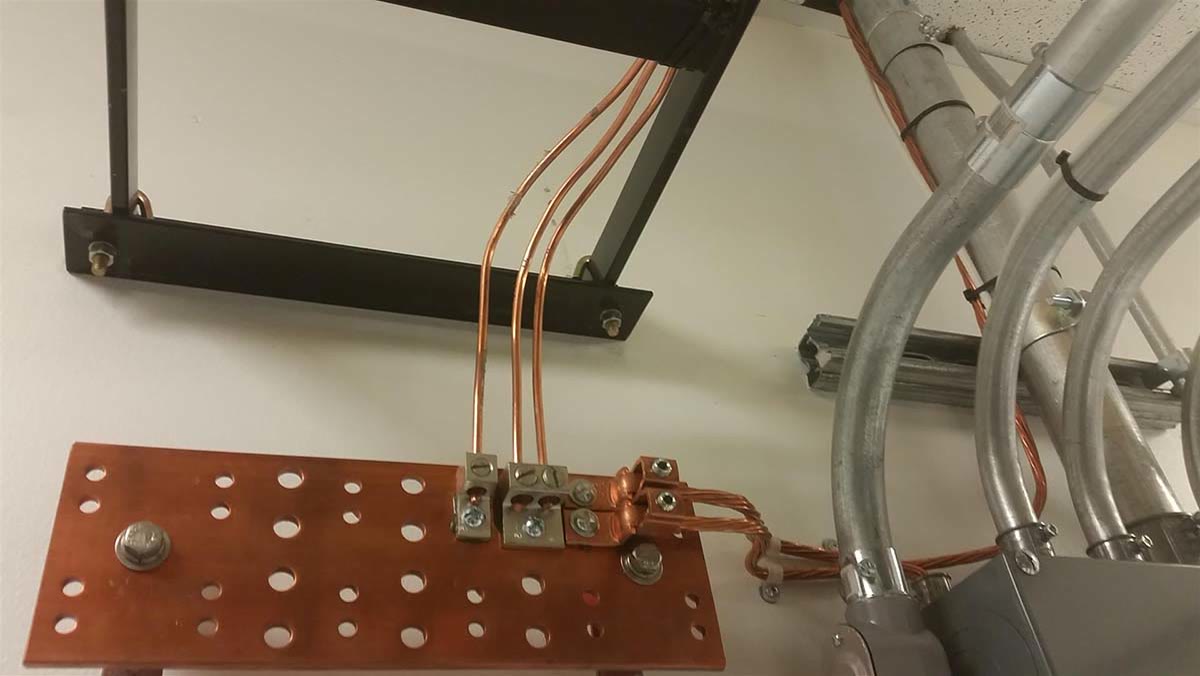
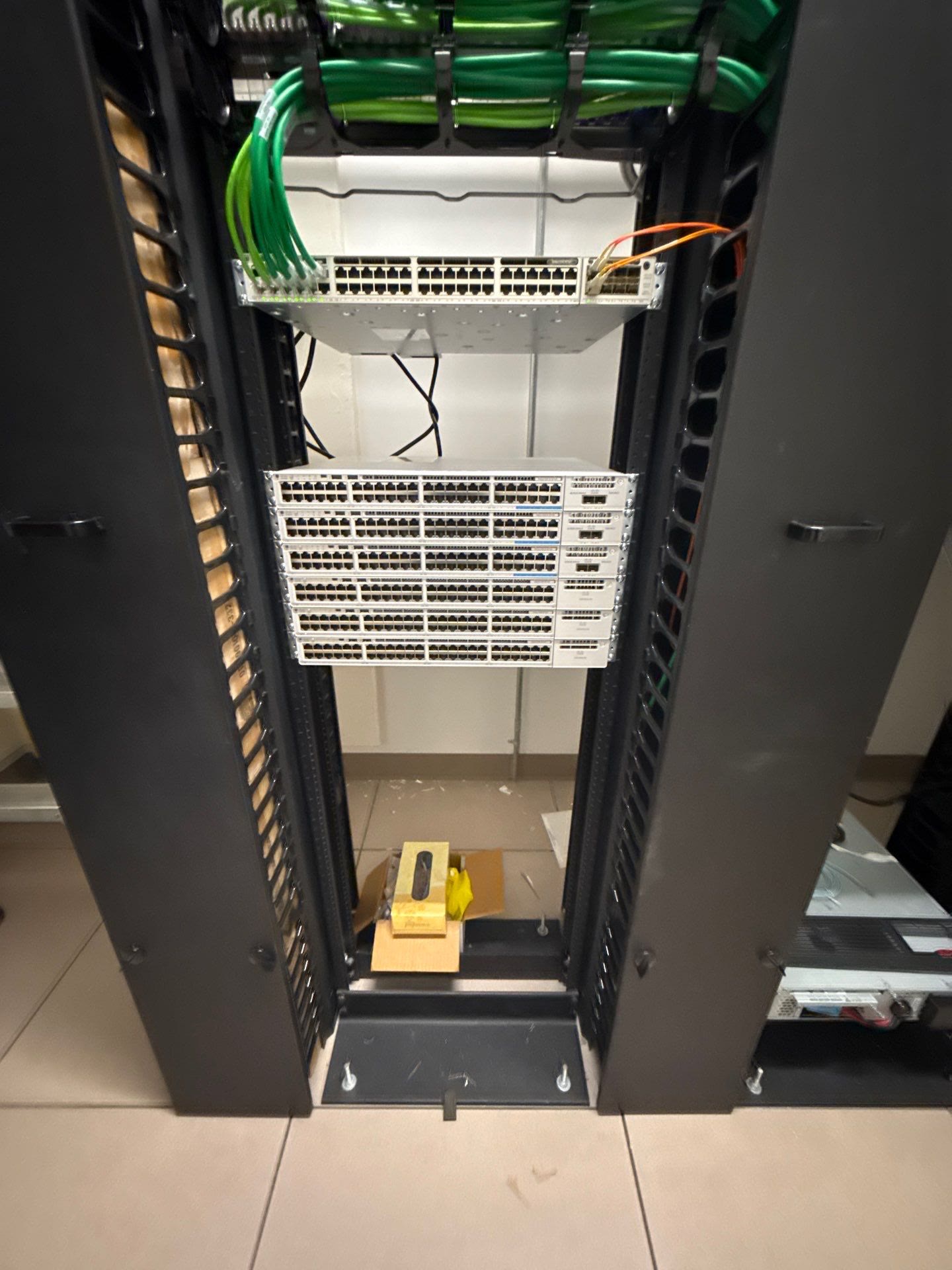
Dressed, labeled patch panels and grounded racks that a stranger could trace.
PoE drops to access point locations planned around the building, not just the ceiling grid.
SECTION 02 / WHAT A RACK SHOULD LOOK LIKE
A rack somebody can trace with their eyes is a rack that gets fixed in minutes instead of hours. Cable management, grounding and labeling are not upsells — they are how the job is supposed to be done.
Licensed crew, twenty-two years in the trade, one invoice for the cable plant.
SECTION 03 / BUILDINGS THAT FIT
SECTION 04 / READ THE LABEL
Published cabling standards, so the conversation starts with the same numbers. What your building needs depends on distance, device count and what you are plugging in at the far end — that is what the walkthrough is for.
Ask which one you need →TIA/EIA-568 · IEEE 802.3 · channel lengths, copper at 10G
SECTION 05 / WHY IT MATTERS
A patch map that lives in one technician's head is a network that breaks the day he doesn't answer the phone. We hand over a labeled record before we leave — that is the actual deliverable, not the cable.
SECTION 06 / CERTIFY, DON'T EYEBALL
Drops get a certification test as part of the process, alongside the visual check. That is the difference between a network you can trust under load and one that works fine until it doesn't.
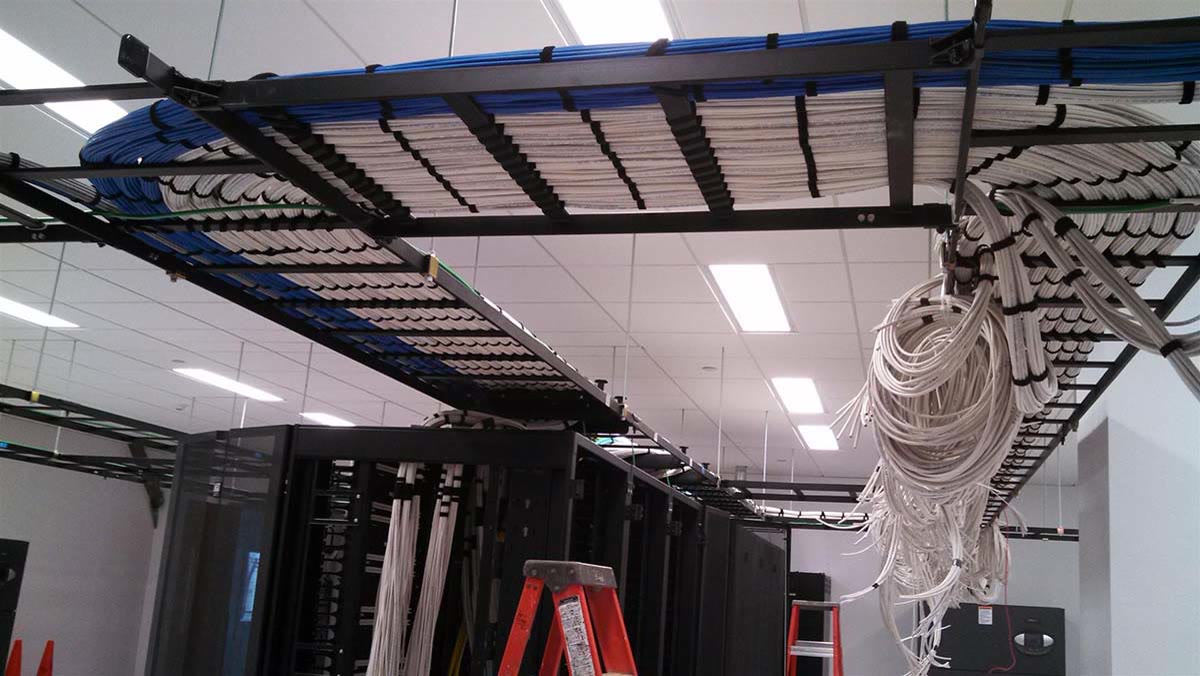
Dressed, not dumped
SECTION 07 / DUE DILIGENCE
Four questions worth asking any bidder, including us.
SECTION 08 / THE RUN
One cable. Five stations.
Drops, closets, distances, what's already in the walls.
Category, routes, materials and a number you can compare.
Home-run to the rack, dressed and grounded.
Testing and certification before handover.
A labeled record of what port feeds what.
SECTION 09 / THE OTHER TRADES
You own the switches and the network. We get the copper and the fiber to where you need them, terminated, tested and labeled.
We work to your schedule and alongside your trades. Off-hours and weekend pulls in occupied buildings are normal for us.
One licensed, bonded, insured contractor for the cabling across your buildings.
SECTION 10 / THE PART NOBODY SEES
A copper bus bar, bonded properly, is unglamorous and it is also the reason a rack full of switches doesn't develop ground loops six months later. We do it every time, not just when someone asks.
TELECOM ROOM
A telecom room does specific jobs an ordinary closet does not: it holds temperature and humidity within a range the equipment tolerates day and night, not just during business hours; it runs off a dedicated circuit so a tripped breaker in a break room doesn't take the network with it; and it gives a technician clearance to stand in front of an open rack without turning sideways. A plywood backboard on one wall carries the ground bar and any wall-mounted gear. The door swings out, not in, so it never blocks the rack it's protecting. None of this shows up on a floor plan drawn before the network was scoped — it gets added, or worked around, after the fact.
PATHWAY & SEPARATION
Low-voltage data cable and power conductors share a lot of the same ceiling space, and code sets rules for how close they get. Run copper cable parallel and close to a lighting ballast, a motor, or a transformer for any distance and it can pick up enough electrical noise to show up as errors on a live link — the cable still passes a continuity check, but the network drops packets under load. Where a data run has to cross power, it crosses at ninety degrees, not alongside it. Cable tray gets filled to a fraction of its capacity, not packed tight, so a cable can still be pulled or added later without damaging what's already resting on it. None of this is visible once the ceiling tile goes back up.
TOPOLOGY & DISTANCE
Structured cabling is built as a star: every outlet runs its own cable back to one telecom room, and no drop ever daisy-chains from one device to the next. That single rule is what makes a bad cable a one-outlet problem instead of a building-wide one. The star has a distance budget, too — a permanent link tops out at ninety meters, and the patch cords at each end eat into the same hundred-meter ceiling. That number is routed distance, not straight-line: a cable that climbs a wall, crosses a plenum and drops down a chase can burn through the budget on a run that looks short on a drawing. A telecom room on the wrong floor doesn't get a pass on the math — it just runs out of reach.
POWER BUDGET
Every powered port has a class rating, but the number that actually matters is the switch's total PoE budget — the sum every port can draw from one power supply. Fill a switch with cameras, access points and badge readers and it's easy to spec a device count that the per-port rating allows but the chassis wattage does not, which is a gap you find at the worst time, not during the walkthrough. Load also has a physical side: a bundle of cables all carrying near-maximum PoE current heats up, and the more cables cinched together the more that heat has to dissipate somewhere, which is why guidance caps how many fully loaded cables belong in one bundle. Tallying device wattage before finalizing cable count is a planning step, not an afterthought.
CERTIFICATION PARAMETERS
A tone-and-probe check confirms a cable is connected. Certification checks whether it performs. A certifier runs an autotest against published limits for wire map, length, insertion loss, near-end crosstalk (how tightly a pair's twist keeps it from bleeding noise into its neighbor), return loss, and propagation delay and skew between pairs (the timing difference between pairs once you push gigabit traffic across all four). Each parameter gets its own pass, fail, or marginal reading against the limit line for that cable category, not a single pass/fail for the whole link. A drop that's within spec on length and wire map can still fail on crosstalk if it was terminated with too much twist pulled out at the jack. That's the difference a report catches and a visual check does not.
BACKBONE RISERS
The backbone that ties an IDF on one floor back to the MDF has to get from one floor to the next, and that means crossing a fire-rated floor or wall assembly. Each penetration needs a firestop system rated to match that assembly, sized to the actual bundle of cable passing through it — not an oversized sleeve left open around the edges for whatever gets added later. That habit is exactly the problem: a riser sleeve opened up to make room for a future add and never resealed is a fire-rated floor that no longer performs to its rating, and it's how that rating quietly falls out of compliance years after the original build-out, long before anyone re-inspects it. Planning the riser pathway and its firestop at design stage, before the backbone is pulled, is what keeps that from happening.
DEMARC TO MDF
Every building has a demarcation point — the spot where the carrier's incoming service physically ends and the building's own cabling begins, usually a small box near where the service enters. Past that box, extending the connection back to the actual MDF is the building's scope, not the carrier's, and it's a step that gets missed in a lease or a build-out because nobody assigned it to anyone. For a facility where downtime actually matters, that single entrance point is also a single point of failure: one cut line at the property boundary takes the whole building offline regardless of how redundant the network is inside the walls. Planning a second physical entrance path, on a different side of the building, is what makes that redundancy real instead of theoretical — and it has to be planned before the conduit under the parking lot gets poured.
SECTION 11 / LICENSED, BONDED, INSURED
Verify any of them before you hire anybody, including us.
SECTION 12 / BEFORE YOU CALL
Cat6 runs 10 Gbps to about 55 meters; Cat6A holds 10 Gbps to the full 100 meter channel and handles higher PoE loads with less heat buildup in a bundle. Which one you need depends on distance and device count, which is what the walkthrough sets.
Drops are terminated and tested as part of handover, and you get a labeled patch map.
Often, yes. We walk the site first and tell you what is reusable before quoting anything.
Yes, both OM4 multimode and OS2 single-mode for backbone runs and building-to-building links.
We hold Oregon CCB #249201, Oregon electrical licence 4911LEA, CLE723 and Washington licence KNEPPJK854KK, with $2,000,000 in liability insurance and a $50,000 bond.
Book a walkthrough. We count drops and closets, then you get a written scope and price you can compare against anyone else's.
SECTION 13 / NEXT STEP
Licensed, bonded and insured · 5.0★ on Google, 18 reviews · 24/7 on call from Milwaukie, OR.
Move your cursor across this band