
LOW VOLTAGE CABLING / WHAT IT IS
Every camera, badge swipe and phone call runs on cable somebody pulled.
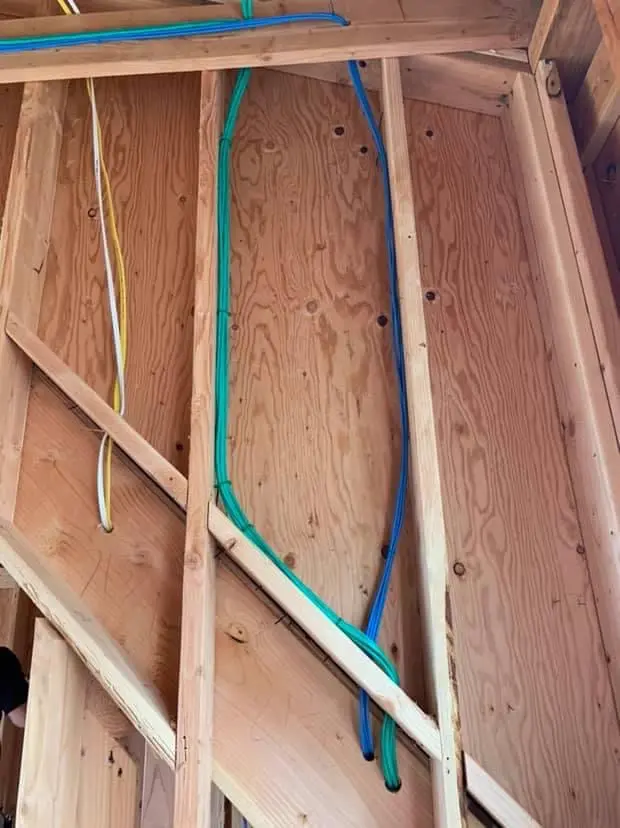
Structured cabling is the copper backbone every other low-voltage system rides on — cameras, access control, Wi‑Fi, phones, fire alarm, all of it. Pulled through walls and ceilings, dressed onto trays, terminated at a labeled patch panel. Get this part wrong and every system built on top of it inherits the problem.
LOW VOLTAGE CABLING / WHERE IT SHOWS UP
Satellite centers, operating rooms, cannabis compliance.
Every one of those relies on structured cabling underneath it. Satellite centers and operating rooms where the network cannot go down mid-procedure. Cannabis cultivation and retail facilities where the security and lab-compliance systems all ride on the same backbone. Tenant improvements, warehouses and campuses where the cabling plan decides how the building performs for the next twenty years, not just the next tenant.
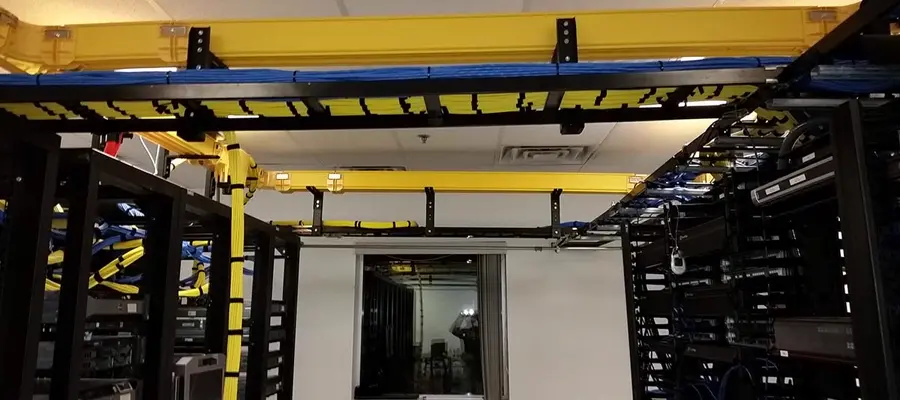
Rack room
Dressed, labeled, and built for the technician who opens this door next.
LOW VOLTAGE CABLING / WHY IT MATTERS
The part of the building nobody notices, until it fails.
Nobody tours a building to admire the cable plant. But when a camera drops out, a badge reader stops responding, or a conference room can't hold a video call, the cabling is almost always where the problem actually lives. Cable pulled to standard and labeled honestly is cheaper to diagnose for the rest of the building's life than cable pulled fast and left unlabeled.
LOW VOLTAGE CABLING / READ THE LABEL
The spec sheet.
Published cabling standards, so the conversation starts with the same numbers. What your building needs depends on distance, device count and what is plugging in at the far end — that is what the walkthrough is for.
Ask which one you need →TIA/EIA-568 · IEEE 802.3 · channel lengths, copper at 10G
LOW VOLTAGE CABLING / WHAT'S INCLUDED
Three things every job includes.
Pulled to standard
Dressed, bundled and routed the way the next technician expects to find it, not just tucked out of sight.
Terminated & tested
Drops terminated and tested before handover, with a labeled record of the result.
Labeled
A record of what went where, at the patch panel and at the wall plate, so nobody is guessing in six months.
LOW VOLTAGE CABLING / THE PROCESS
From walkthrough to certification.
One cable. Five stations. The signal moves as you scroll.
- 01
Walkthrough
We look at the building, not a drawing. Pathways, distances, what's already in the walls.
- 02
Design & quote
Drop counts, routes, cable category and a number, written down.
- 03
Install
Licensed crew, pulled to standard, dressed and labeled, around your schedule and your trades.
- 04
Terminate & test
Drops terminated and tested before handover.
- 05
Hand over
A labeled record of what went where, so the next person is not guessing.
LOW VOLTAGE CABLING / DUE DILIGENCE
Before you hire anybody.
Four questions worth asking any cabling bidder, not just us.
- Look up the CCB number.Oregon publishes licence status, bond and insurance for every contractor. Ours is #249201.
- Ask what category of cable is actually being pulled.Cat5e sold and billed as Cat6 is a real problem in this trade. Ask for the cable's own printed markings if you're unsure.
- Ask how drops are tested and documented.A labeled record of what went where is the difference between a network and a mess.
- Ask who is actually pulling the cable.A licensed crew, not a subcontractor of a subcontractor.
LOW VOLTAGE CABLING / WHO CALLS US
We know we are not the only crew on site.
General contractors
We work to your schedule and alongside your other trades. Off-hours and weekend pulls in occupied buildings are normal for us.
IT providers
You own the switches and the network. We get the copper to where you need it, terminated, tested and labeled.
Property & facility managers
One licensed contractor for the cabling across every building you manage, instead of whatever the last tenant's vendor left behind.
STRUCTURED CABLING ARCHITECTURE
Every jack answers to one telecom room.
Structured cabling follows a hierarchical star, not an as-needed sprawl. Every work-area jack home-runs back to one serving telecommunications room — never daisy-chained to another jack or looped through a furniture whip. A horizontal link is capped at 90 meters from patch panel to wall jack; add patch cords on each end and the total channel tops out at 100 meters, which is why telecom room placement gets decided at the design stage, not wherever a closet happens to be free. In a multi-floor building, one main distribution frame feeds intermediate distribution frames on other floors over riser backbone, copper or fiber depending on distance and bandwidth needs. Get the topology wrong and no amount of careful termination fixes it later.
- Channel limit90 meters horizontal link, 100 meters total channel once patch cords are added on each end.
- Home-run ruleEvery drop home-runs to its serving telecom room — never daisy-chained to another jack.
- Riser architectureMain distribution frame feeds intermediate distribution frames over riser backbone on multi-floor jobs.
- Backbone mediaRiser backbone runs copper or fiber depending on distance and bandwidth needs.
- Room placementTelecom room location gets fixed at the design stage, before drywall goes up.
ELECTROMAGNETIC SEPARATION
Data cable and power don't share a path.
Twisted-pair cable rejects a lot of noise, but not induced current from a power conductor running tight and parallel for any distance. The fix is geometry: cross a power run at roughly 90 degrees and the coupling drops close to zero; run parallel for twenty feet in the same tray and it doesn't. Code-referenced separation distances scale with the power circuit's voltage and load classification, not a flat number pulled from habit. Fluorescent ballasts, transformers, and variable-frequency drives in mechanical rooms are the usual offenders. On a commercial job with several trades in the ceiling at once, someone else's power whip ends up sharing a tray with the data cable more often than anyone plans for — catching it at rough-in is cheaper than chasing intermittent errors after ceiling tile goes back up.
- Crossing angleCrossing a power run at roughly 90 degrees cuts induced coupling to near zero.
- Separation ruleRequired separation distance scales with the power circuit's voltage and load classification, not a flat rule.
- Common sourcesFluorescent ballasts, transformers, and variable-frequency drives are the common noise sources in mechanical rooms.
- Rough-in checkA shared cable tray with unconditioned power gets caught at rough-in, not on test day.
TELECOM ROOM DESIGN
The closet is the room that gets ignored.
A telecom room gets designed, not repurposed from whatever closet was left over. Termination hardware and wall-mount racks need a plywood backboard rated to hold their weight, not drywall and anchors. Power comes from a dedicated circuit — not shared with the room's light switch, so someone flipping a switch on their way out doesn't drop every rack in the room. Active equipment throws off heat that the original HVAC load calculation never accounted for, so the room needs continuous ventilation or dedicated cooling sized for what's actually installed. No domestic water, drain, or sprinkler branch line gets routed overhead if it can be routed around instead. Every rack needs clearance front and back, because a room that fits today's install with zero slack has no room for the next set of moves and adds.
- BackboardPlywood backboard rated to carry termination hardware and wall-mount rack weight.
- Dedicated powerDedicated power circuit, not shared with the room's light switch.
- CoolingContinuous ventilation or dedicated cooling sized for the equipment load, separate from the original HVAC calc.
- Overhead plumbingNo domestic water, drain, or sprinkler branch line routed overhead where it can be avoided.
- Rack clearanceFront and rear rack clearance held for future moves, adds, and changes.
LABELING AND RECORD-KEEPING
A cable with no label is a liability.
A cable with no label is a liability the day the original installer isn't answering the phone. Administration standards call for a unique identifier on every jack, patch panel port, and the cable run connecting them, cross-referenced so a port number on a panel points to an exact room and outlet. That scheme gets documented into an as-built record at project closeout, not sketched from memory afterward. The real test isn't how it looks on install day; it's whether a facilities tech five years later, with no memory of the project, can trace a single run cold from a floor plan and a panel label without a callback. Buildings change hands and IT staff turns over. The label scheme is what outlives everyone who was in the room during install.
- Identifier schemeEvery jack, patch panel port, and run gets one identifier, cross-referenced end to end.
- Documented standardLabel scheme follows a documented standard, applied consistently, not improvised per closet.
- As-built recordAs-built record ties physical location to port number, delivered at project closeout.
- Traceability testA run should be traceable cold by someone who wasn't on the original job.
GROUNDING AND BONDING
Racks bond to ground before anything else.
Every rack, cable tray, and piece of termination hardware bonds to a telecommunications grounding busbar, which in turn bonds to the building's electrical ground system through a sized bonding conductor — not a length of scrap wire run because something had to connect to something. This isn't optional hardware. An ungrounded rack is a shock hazard the moment a fault current has nowhere else to go, and in a building full of other electronic equipment, an inconsistent ground reference shows up as noise and ground loops that read as intermittent, unexplainable errors on the network long after installation. Bonding gets verified before a rack is loaded with active equipment, because it is far harder to trace a ground fault through a fully populated rack than to check continuity on an empty frame.
- Grounding busbarTelecommunications grounding busbar bonds every rack and cable tray to building ground.
- Conductor sizingBonding conductor sized and routed to the applicable standard, not a scrap of wire.
- Shock hazardAn ungrounded rack is a shock hazard during a fault, beyond any signal-quality concern.
- Ground loopsGround loops from inconsistent bonding read as intermittent errors that are hard to trace later.
- Verification timingBonding gets verified before a rack is loaded with active equipment, while it's still easy to check.
ABANDONED CABLE
Abandoned cable in a ceiling is a hazard.
Cable that isn't terminated at both ends and isn't tagged for future use has to come out of the building, not get left coiled above the ceiling tile. Code treats an abandoned cable jacket in a plenum space as fuel load and a smoke-and-combustion-byproduct source in a fire, which is the actual reason it can't just stay put. Tenant-improvement and retrofit work is where this piles up fastest — a ceiling that's had four tenants can have four generations of dead cable stacked on top of whatever's currently live. Before any demolition starts, every existing run in that ceiling gets traced and tagged live or dead. Nothing gets removed on an assumption, because the one cable someone assumes is dead is the one still carrying something.
- Removal ruleCable with no active termination and no tag for future use must be removed.
- Tenant turnoverPlenum ceilings accumulate abandoned cable fastest in buildings with a history of multiple tenants.
- Pre-demo tracingEvery existing run gets traced and tagged live or dead before demolition starts.
- No guessingUntagged assumptions get tested the hard way — nothing gets cut on a guess.
- Code concernAbandoned cable jacket left in place adds fuel load and smoke in a fire, which is the code's actual concern.
FIBER BACKBONE
Distance decides copper or fiber.
Copper has a practical distance limit; backbone runs that exceed it, or that need electrical isolation between separate buildings, get specified in fiber instead. Singlemode carries farther and has more headroom for whatever bandwidth comes next; multimode costs less per port over a shorter backbone run and is often enough for it. Splicing method matters more on a backbone than on a patch cord: a fusion splice fuses the glass itself and holds a lower, more stable loss over the life of the cable than a mechanical or field-installed connector, which is why backbone runs get fusion spliced rather than field-terminated wherever practical. Certification is different too — a trace reports loss and reflectance at every splice and connector along the run, not a simple pass or fail the way a copper channel test does.
- Fiber triggerBackbone distance beyond copper's practical reach, or a need for building-to-building electrical isolation, is when fiber gets specified.
- Mode selectionSinglemode carries farther with more bandwidth headroom; multimode costs less per port over shorter backbone runs.
- Splicing methodFusion splicing gives lower, more stable loss over the cable's life than a mechanical or field connector.
- Certification reportBackbone certification reports loss and reflectance at every splice and connector, not a simple pass or fail.
LOW VOLTAGE CABLING / BEFORE YOU CALL
Straight answers.
What's the difference between Cat5e, Cat6 and Cat6A?
Cat5e is rated for 1 Gbps at up to 100 meters. Cat6 handles 10 Gbps but only to about 55 meters before that speed drops off; Cat6A holds 10 Gbps for the full 100 meters. Which one you need depends on run length and what you're plugging in at the far end — that's a walkthrough conversation, not a guess.
Do you pull cable for other trades, like a camera or access-control vendor?
Yes, that's common. We pull, terminate and label the cabling to spec even when another vendor is supplying and configuring the end device.
Can you take over a job someone else started?
Often, yes. We walk the site first and tell you what is reusable and what is not before quoting anything.
Do you do residential?
Our specialty is commercial and industrial installations. Tell us about the project and we will say honestly whether we are the right fit.
Are you licensed for this work?
We hold Oregon CCB #249201, Oregon electrical licence 4911LEA, CLE723 and Washington licence KNEPPJK854KK, with $2,000,000 in liability insurance and a $50,000 bond.
How do I get a quote?
Book a walkthrough. We look at the building, then you get a written scope and price you can compare against anyone else's.
LOW VOLTAGE CABLING / NEXT STEP
Pulled once. Labeled right.
Tell us the building and the drop count, even a rough one. We'll come look at it.
Move the pointer across this band