U01
Initiating devices
Smoke and heat detectors, manual pull stations — the devices that detect and report.
FIRE ALARM · CCB #249201 · MILWAUKIE, OR
Fire alarm work is performed under the same Oregon and Washington licences as our other low voltage work, and it goes through the same permitting and inspection process as any life-safety system.
SECTION 01 / WHAT'S IN A FIRE ALARM SYSTEM
General reference on the parts of a system, not a design for any specific building — actual device counts and placement are set by your local fire marshal or authority having jurisdiction (AHJ), and confirmed on the walkthrough.
Smoke and heat detectors, manual pull stations — the devices that detect and report.
Horns, strobes and speakers that alert people in the building.
The panel that supervises every device and controls what happens when one trips.
The link that notifies a monitoring service or dispatch when the system trips.
SECTION 02 / SAME LICENCES, SAME STANDARD
Oregon CCB #249201, Oregon electrical licence 4911LEA, CLE723 and Washington licence KNEPPJK854KK cover this work the same way they cover cabling, cameras and access control. Fire alarm systems are permitted and inspected like any life-safety system — that isn't optional, and we don't treat it that way.
SECTION 03 / BUILDINGS THAT NEED IT
SECTION 04 / READ THE LABEL
General fire-alarm system vocabulary, for reference — not a design for any specific building. Actual code requirements are set by your local fire marshal or AHJ, not by us.
Ask what your building needs →General reference only. Code requirements are set by your local AHJ.
SECTION 05 / WHY IT MATTERS
This is the one system in the building where "it probably works" is not an acceptable standard. Permitted, inspected, licensed — every time, not just when someone asks.
SECTION 06 / DURING A TENANT IMPROVEMENT
A building under construction is still a building somebody occupies, at least part of the time. Coverage doesn't lapse between the old system coming out and the new one being signed off — that handoff is part of the plan, not an afterthought.
COMMERCIAL LOW VOLTAGE, EVERY DAY
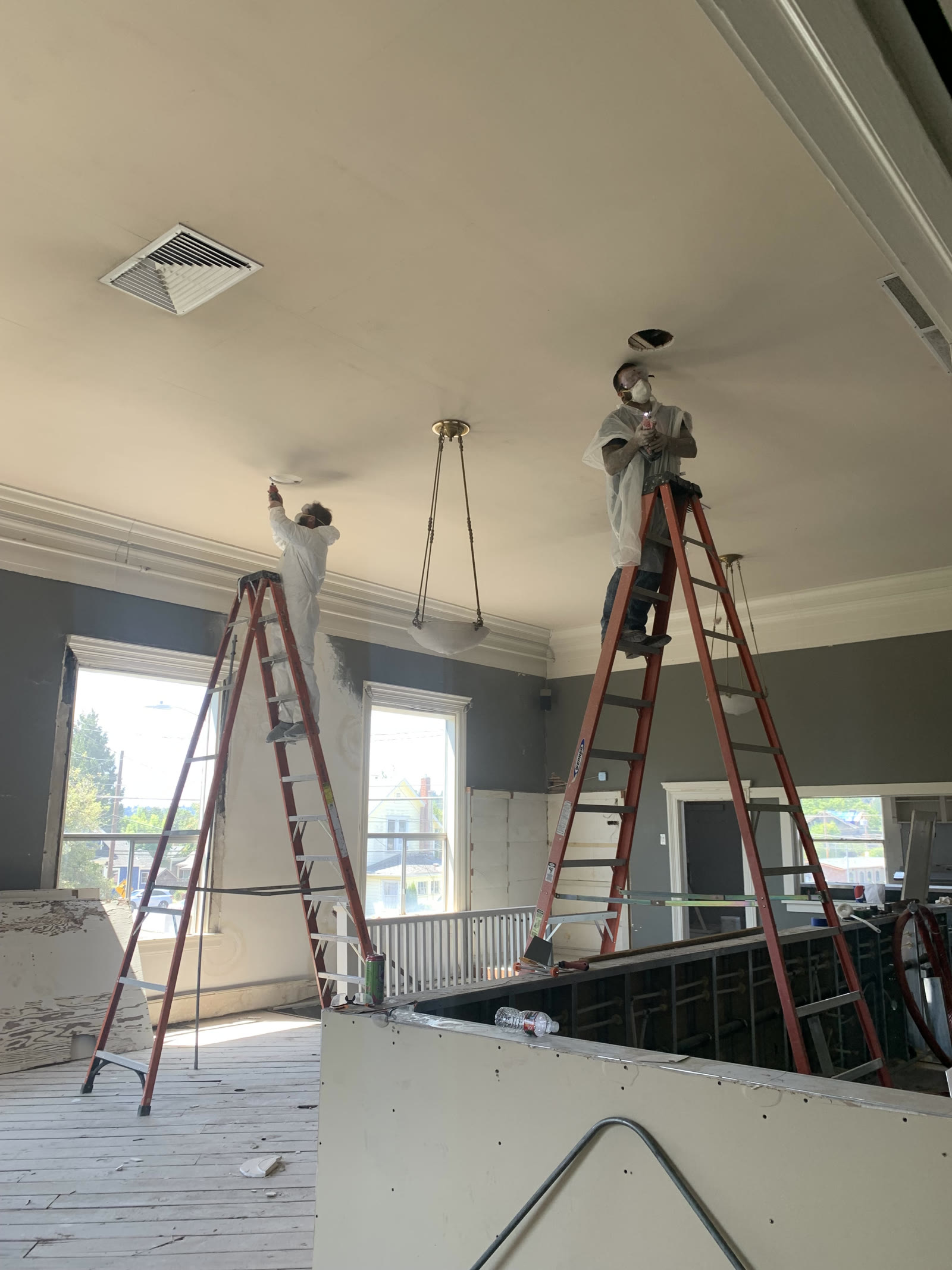
Same crew, same ladders, same standard as the cabling and cameras job next door — fire alarm just happens to be the one that gets inspected.
SECTION 07 / DUE DILIGENCE
Four questions worth asking any bidder, including us.
SECTION 08 / THE RUN
One cable. Five stations.
Device count and placement coordinated with your AHJ.
Scope, materials and the permit filed before work starts.
Devices, panel and wiring, licensed crew, around your schedule.
Every device and the monitoring link tested.
Signed off by the AHJ, documentation handed to you.
SECTION 09 / THE OTHER TRADES
Tenant-improvement timelines, permit coordination and inspection scheduling, folded into the overall project schedule.
Upgrades to an existing system, coordinated so coverage never lapses.
Life-safety work in occupied buildings, scheduled around patients, staff and operations.
SECTION 10 / THE PART THAT LOOKS BORING
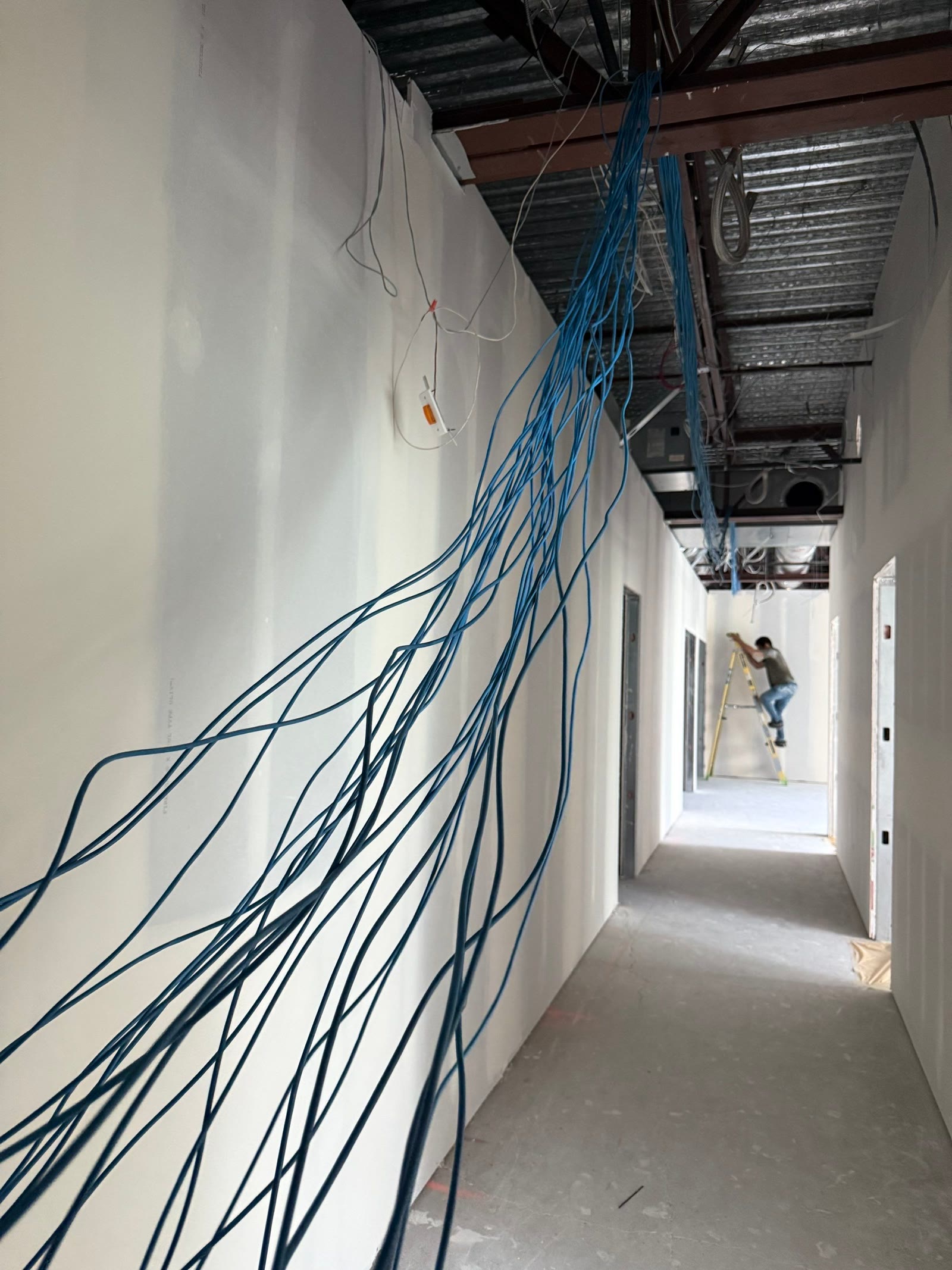
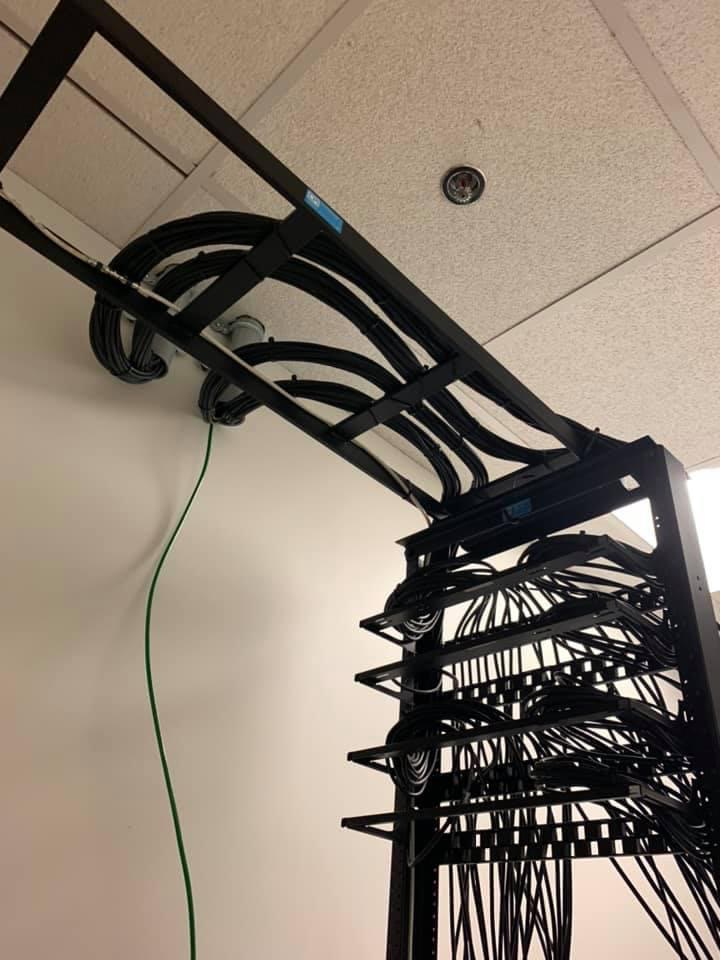
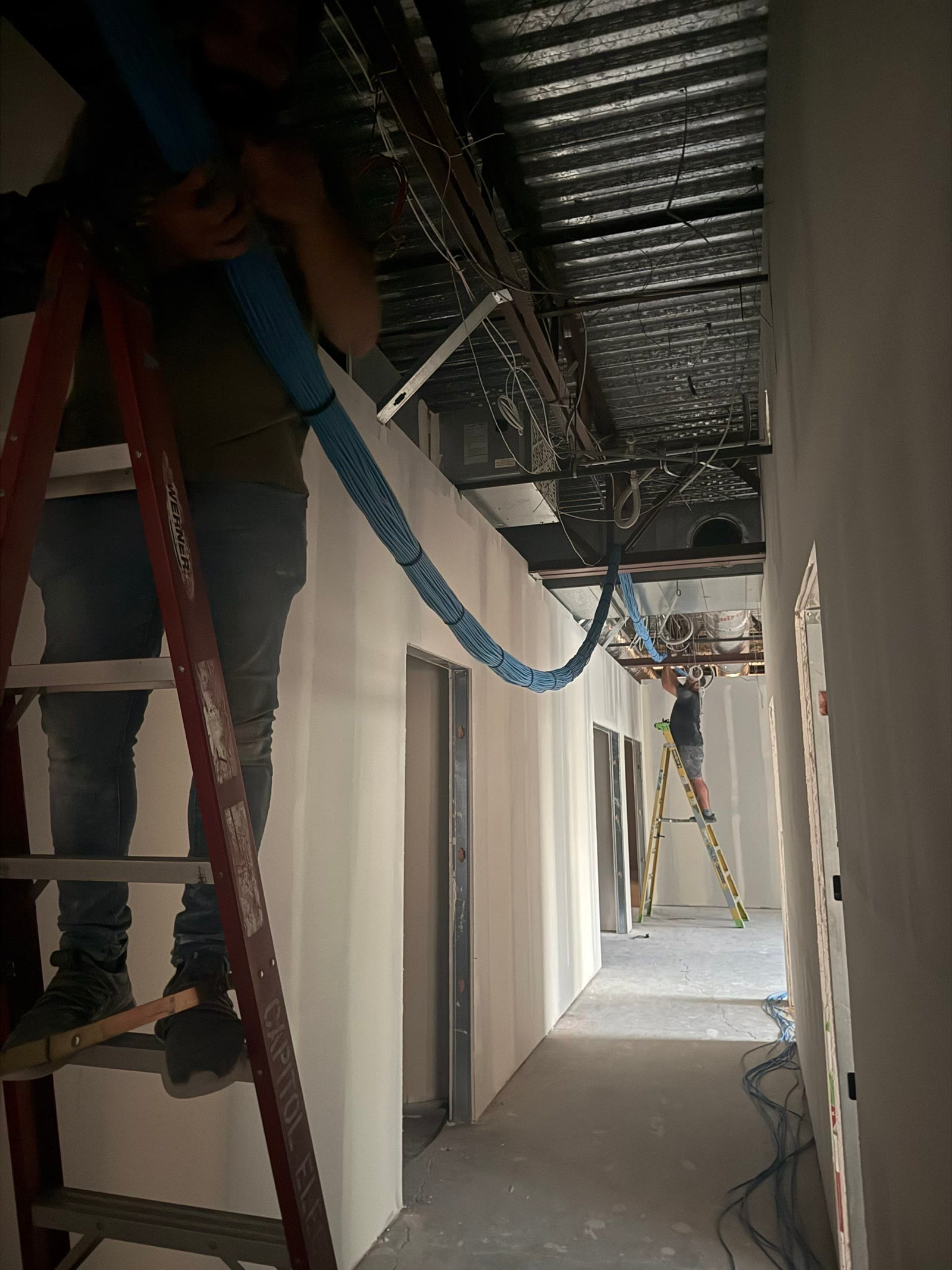
Fire alarm circuits run through the same ceilings, chases and walls as every other low voltage system on the job. Pulled and dressed to the same standard, because it's the same crew and the same licence doing it.
SIGNALING LINE TOPOLOGY
A fire alarm initiating circuit is wired either conventional — an Initiating Device Circuit, or IDC — or addressable, a Signaling Line Circuit, or SLC, and the difference shows up the moment something trips. Conventional IDC wiring groups devices onto a zone; the panel tells you which circuit alarmed, not which device. Addressable SLC wiring gives every detector, pull station and monitor module its own address, so the panel display names the exact device and its mapped location. Wiring topology matters just as much on either circuit type: Class B wiring runs out and dead-ends at an end-of-line resistor, so a single break drops everything past the break. Class A wiring loops back to the panel, so the same break still leaves every device reachable from the other direction, which is why some occupancies and jurisdictions require it. The device address list, mapped against a floor plan, belongs in the closeout package, not just in the panel's memory.
CAUSE AND EFFECT
A fire alarm signal is rarely the only thing that happens when the system goes into alarm. Elevators recall to a designated landing under Phase I service and switch to firefighter operation under Phase II. Corridor doors held open on magnetic holders release and swing shut to hold back smoke. Doors on magnetic locks for access control release on alarm, because egress law overrides any security function the moment there's a fire condition. HVAC equipment shuts down or dampers close to stop smoke from following ductwork through the building. A sprinkler waterflow switch is itself an initiating device that puts the whole system into alarm; a tamper switch on the same system is supervisory only, reporting a valve moved off its normal position. All of it is documented in a cause-and-effect matrix filed with the permit drawings and checked against the actual field wiring at commissioning, so the sequence on paper matches what the building does.
DETECTION TECHNOLOGY
Photoelectric detectors sense light scattered by smoke particles and respond well to smoldering, visible smoke. Ionization detectors respond faster to fast-flaming fires but are more prone to tripping on cooking and steam. Combination or multi-criteria detectors weigh smoke and heat together to cut down on both kinds of nuisance trips. None of that helps in a space with heavy return airflow, high ceilings, or constant dust and particulate, which is where a ceiling-mounted spot detector either misses the fire condition or false-alarms on a normal day. Aspirating smoke detection solves that differently: a network of small-bore sample pipe draws air continuously through drilled holes back to one sensitive sensor, catching smoke at concentrations a spot detector would never register, in places a spot detector can't physically reach or can't be trusted in. Choosing between them is a design decision made for the specific space.
SECONDARY POWER
Every fire alarm system has to keep working through a power outage, then still deliver a full alarm at the end of it — commonly a full day of standby, followed by a defined period in alarm, longer again for a system that pages voice instructions over speakers instead of just sounding a horn. Getting the battery right means adding up every device's standby draw across the whole signaling line, adding the much larger draw of every notification appliance the moment it activates, and applying an aging derate so the battery still meets the calculation years into its service life, not just on day one. That number gets written down and kept with the system records. A battery sized off a guess, or off whatever came in the panel box, is the kind of shortcut that only shows up during an actual outage.
INSPECTION, TESTING, MAINTENANCE
Fire alarm systems are tested on intervals set by code, not by whoever remembers to do it. Devices get checked on a schedule, the battery gets load-tested rather than just read at rest, and the signal to the monitoring or central station gets confirmed as actually arriving, not assumed. Smoke detectors have a service life; sensitivity drifts as dust and age build up inside the chamber, which is why sensitivity testing exists and why detectors get replaced outright once they're old enough, rather than tested indefinitely. Every one of those checks produces a record: device-by-device, pass or fail, signed and dated. That record of completion is what a fire marshal, an insurer, or a future building owner actually wants handed to them — a verbal "it's fine" is not documentation, and it doesn't hold up when someone asks for the file.
FALSE ALARM CAUSES
A detector mounted too close to a supply air diffuser has smoke diluted and dispersed by the airflow before it ever reaches the sensing chamber, or collects dust and debris carried by that same airflow over time — the first causes a missed condition, the second causes a nuisance trip. One near a kitchen, loading dock, or any space that produces steam or dust sees enough particulate on an ordinary day to false alarm. Insects work their way into an open sensing chamber over years and eventually register as smoke themselves. None of that gets fixed by swapping in a different detector model — it gets fixed by moving the device, changing its spacing relative to the diffuser or door, or reconfiguring the panel to require a second device to confirm before it declares a full alarm. That cross-zoning or verification logic costs a few seconds of confirmation time in exchange for far fewer false dispatches, which matters in a building where repeat nuisance calls draw attention nobody wants.
VOICE EVACUATION
A single-tone horn-strobe system gives one instruction to the whole building at once: leave, now, everywhere. A voice evacuation system can say something different on different floors — evacuate the floor of origin and the floor above it, where smoke is most likely to spread first, and hold other floors in place while directing people toward a specific stairwell — which matters once a building is tall or large enough that funneling everyone into the same stairwell at the same time becomes its own hazard. Voice systems are judged on intelligibility, not just volume, so speaker count and placement follow acoustic coverage rules rather than even spacing. Strobes carry their own placement math too: candela rating and spacing are matched to room size and ceiling height under visual-notification requirements, sized for the space rather than picked off a shelf.
HAZARDOUS LOCATIONS
Cultivation spaces run high humidity and heavy airborne particulate, both of which push a conventional spot smoke detector toward constant nuisance trips or toward missing a real condition entirely — often the case for aspirating detection instead. Extraction work involving flammable gas or volatile solvent falls under hazardous-location classification, which sets a boundary around the work area and requires explosion-proof or intrinsically-safe devices inside it, while ordinary devices stay outside the line. Where a space also carries a special-hazard suppression system — a clean-agent system protecting sensitive equipment, or a wet-chemical system over a hood — that system's discharge and trouble conditions get wired back into the fire alarm panel as their own monitored zone, so one panel and one set of records covers the whole building's life-safety condition instead of several disconnected systems nobody is tracking together.
SECTION 11 / LICENSED, BONDED, INSURED
Verify any of them before you hire anybody, including us.
SECTION 12 / BEFORE YOU CALL
Yes, under the same Oregon and Washington licences as our other low voltage work: CCB #249201, CLE723, electrical 4911LEA and Washington KNEPPJK854KK. Fire alarm work is permitted and inspected, like any life-safety system.
Permitting and inspection are part of any fire alarm project. We'll cover exactly what that looks like for your building on the walkthrough.
That depends on the system and the building. We'll cover monitoring options during the walkthrough.
Often, yes. We walk the site first and tell you what is reusable before quoting anything.
The Portland metro from our shop in Milwaukie, Oregon. We hold both Oregon and Washington licences.
Book a walkthrough. We look at the building, then you get a written scope and price you can compare against anyone else's.
SECTION 13 / NEXT STEP
Licensed, bonded and insured · 5.0★ on Google, 18 reviews · 24/7 on call from Milwaukie, OR.
Move your cursor across this band